
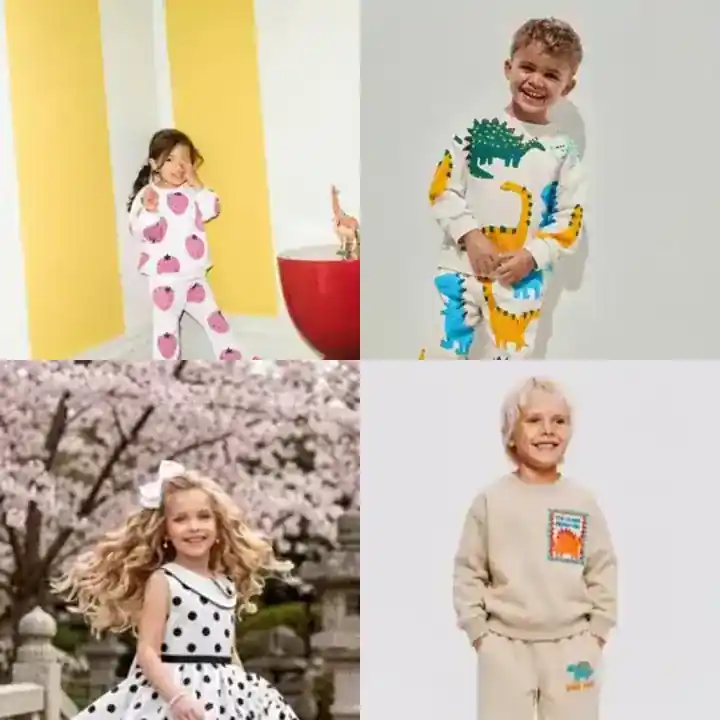
Use age bands to organise demand, not to guess a size
A first planning grid can separate baby products from clothing for children and older children. For example, a buyer may review 0-36 months, 2-8 years and 8-14 years as three commercial groups. The overlap is intentional: suppliers do not all move from baby sizing to numbered children's sizes at the same point.
These groups help with range planning, but they do not replace the size list on a product. A garment described for ages 2-8 may be supplied as 2-3, 3-4 and 4-5, as single numbers, or as height labels. Record the actual series before comparing it with another model.
Treat age as a navigation aid. Height, body measurements and the supplier's stated size run are the buying record.
Give each product type a job in the assortment
T-shirts, sweatshirts and shirts provide tops that can be combined with existing stock. Trousers, shorts and leggings cover the lower half of those outfits. Coats and gilets answer a narrower weather need, while coordinated sets make the complete look clear on the rail and in product photography.
Occasion dresses and children's suits serve a different buying moment from everyday clothes. Sleepwear has its own fit, fabric and labelling questions. Keeping these roles separate makes the order easier to review: a large number of dresses should not accidentally be mistaken for a balanced girlswear range, and several tracksuit colours should not be counted as several different product needs.
| Range role | Typical products | What to verify |
|---|---|---|
| Everyday tops | T-shirt, sweatshirt, shirt | Fabric weight, neckline, repeat colours |
| Everyday bottoms | Trousers, shorts, leggings | Waist adjustment, stretch, inside leg |
| Complete outfits | Tracksuits, two-piece sets | Pieces included and sizes in one series |
| Outerwear | Coats, jackets, gilets | Season, lining, closures and packed volume |
| Occasion | Girls' dresses, children's suits | Lining, trim security and movement |
| Sleepwear | Pyjama sets | Composition, care label and destination rules |
Plan girlswear and boyswear from observed demand
Girlswear, boyswear and baby clothing are practical catalog divisions, but the order still needs detail beneath them. Write down the age, product type, intended use and price position for every series. “Girls, 4-10” becomes more actionable when it is split into daily sets, school-friendly layers and occasion dresses.
For boyswear, separate casual sets from children's suits and formal separates. They are bought for different reasons and often turn at different speeds. Previous sales, customer requests and sizes that sold out are stronger inputs than copying the same percentage split from another shop.
Use collection themes as shop navigation
New models, back-to-school, organic or basic ranges, seasonal reductions, best sellers and new arrivals can help a buyer scan the catalog. They should describe a real property or a dated merchandising decision. A “best seller” label needs sales evidence; “new arrival” needs a clear arrival window; “organic” needs product-level documentation.
A theme should not hide the underlying product facts. A back-to-school page still needs sizes, composition, colour, care information and series quantity. A sale page should preserve the prior and current commercial terms rather than using urgency as a substitute for an assortment decision.
Review the grid before adding more models
List the series already selected by age band and product role. Empty cells reveal missing needs; crowded cells reveal repetition. Then check colour and price distribution within each cell. This method usually produces a shorter, more legible first order than choosing every model independently.
Keep the product code and URL next to each line. The live catalog can change as new models are added, so the final stock position, colour and series are confirmed with the sales advisor before payment.
Start with evidence the shop can actually collect
Useful assortment evidence does not require a complex retail system. Export sales by product and size when possible, then add customer requests that could not be fulfilled, returns with a fit reason, and sizes that reached zero first. For a new shop, record enquiries for several weeks and review competitor ranges only as context. Another retailer's visible stock does not reveal what sold or what remained unsold.
Separate facts from interpretations on the worksheet. “Size 6 sold 12 units from 14 received” is a fact. “Parents prefer larger sizes” is an interpretation that needs more evidence. This distinction prevents one conversation from turning into a full seasonal buying rule. It also makes the reasoning easier to revise when the next delivery produces a different result.
Allocate the budget by role before selecting styles
Divide the open-to-buy amount across core repeatable items, seasonal needs, occasion products and experimental models. The percentages should follow the shop's customer base and calendar; there is no universal split. Holding a small test budget makes it possible to try a new fabric or silhouette without allowing it to displace proven school trousers or everyday sets.
Calculate with series totals rather than imagined single pieces. A model with a modest unit price can require a large commitment when the run has many sizes and each colour is sold separately. Track how much of each role's budget is already used after every selection. This keeps an enthusiastic occasionwear appointment from consuming money reserved for basics.
Balance width, depth and size coverage
Width is the number of distinct models; depth is the quantity held in a model; size coverage is the useful range offered to the customer. Adding width makes the rail look varied, but one series of every design can produce shallow stock. Adding depth supports repeat sales but concentrates the order. The right balance depends on customer traffic, replenishment speed and how strongly a model has been tested.
A complete size run is not automatically useful coverage. A baby shop and a shop serving older schoolchildren need different endpoints. Map every proposed series onto the age-and-height demand grid. If several models stop before the sizes most often requested, the assortment remains incomplete even though each supplier delivered a technically complete run.
Build a colour architecture instead of collecting colours
Group colours into dependable neutrals, seasonal accents and statement options. Review how tops and bottoms combine across brands. A smaller palette with compatible pieces can create more outfits than many unrelated colours. This is especially useful for school and daily ranges where customers may return for a replacement top or a second bottom.
Occasionwear can justify distinctive colour breadth, but the size commitment still applies to every shade. Record whether a colour is confirmed stock, a showroom sample or a planned production option. Photographs viewed on different screens are not a reliable colour standard; use supplier names and, for important matches, request a physical confirmation or accept that batches may vary.
Place seasonal products against the selling calendar
Work backward from the period when customers need the garment. Include production or preparation, freight, customs, receiving, photography and the time required to place stock on sale. A back-to-school range that arrives after classes begin has a shorter selling window even if the products themselves are correct. Outerwear delivered late can also occupy cash and storage until the next cold period.
Use climate and local school or holiday dates from the destination market, not only the season name used by a supplier. “Winter” can describe fabric weight, collection timing or a broad fashion season. Ask what the garment is made for and inspect lining and construction. A collection label is a planning clue, not a temperature rating.
Control concentration across brands and suppliers
A concentrated order can simplify communication and create coherent presentation, but it increases exposure to one fit, delivery schedule or commercial decision. A highly fragmented order creates its own cost through many small confirmations and inconsistent labels. Measure concentration by budget and piece count, then decide whether it is intentional.
Keep brand fit notes separate. If one supplier's older-child range runs narrow, that should inform size depth without being generalized to Turkish childrenswear as a whole. When introducing a new supplier, start with products whose specifications and series are clear enough to compare. Novelty is less useful when basic order data remains unresolved.
Score the proposed range before confirmation
Review each model for intended customer, use, size coverage, colour role, price position, series commitment, expected arrival and evidence for demand. A simple red-amber-green mark can identify unanswered questions, but retain the written reason. “Amber: care label not received” leads to an action; an unexplained amber circle does not.
Then review the assortment as a whole. Check for duplicated products, missing basics, overrepresented ages and a cluster of prices with no entry or premium option. Remove a model when it adds no clear role. A smaller range with documented reasons is easier to explain to the sales team, photograph for customers and evaluate after the season.
Define the measures that will judge the assortment
Decide before arrival how the range will be reviewed. Useful measures include sell-through by size, weeks until the first stockout, return or exchange reason, gross margin after known costs and the amount of stock remaining at the end of the intended season. Choose a small set the shop can record consistently rather than a dashboard full of incomplete figures.
Compare products within similar roles and selling windows. A formal dress and a basic legging should not be expected to turn at the same speed. Note promotions and late deliveries because they affect the result. When the next order is planned, these measures turn the original assortment grid into a learning record instead of a one-time buying exercise.
Worked example: edit an assortment before it consumes the budget
Imagine a proposed 300-piece order in which 120 pieces are girls' occasion dresses, 90 are coordinated sets, 45 are tops, 30 are bottoms and 15 are outerwear. The shop's records show frequent requests for school layers and trousers, while occasionwear sells around local celebration periods. The grid makes the mismatch visible: the proposed order reflects what looked striking in the showroom more than the shop's recorded demand.
The buyer removes two similar dress models, reduces colour breadth in another, and uses the released series budget for neutral trousers, sweatshirts and an older-child set. Size mapping then reveals that several remaining products concentrate on ages 3-6. One younger run is exchanged for an 8-14 run. The revised order has fewer distinct designs, but broader useful coverage and clearer roles for daily, school and occasion demand.
The shop documents the change and chooses measures for review: sell-through by size after eight weeks, stockouts in core products, exchanges linked to fit and remaining occasion stock after the event period. If the evidence later supports more dresses, the next buy can expand them deliberately. The grid does not dictate taste; it exposes the financial and size consequences of the choices already being made.