
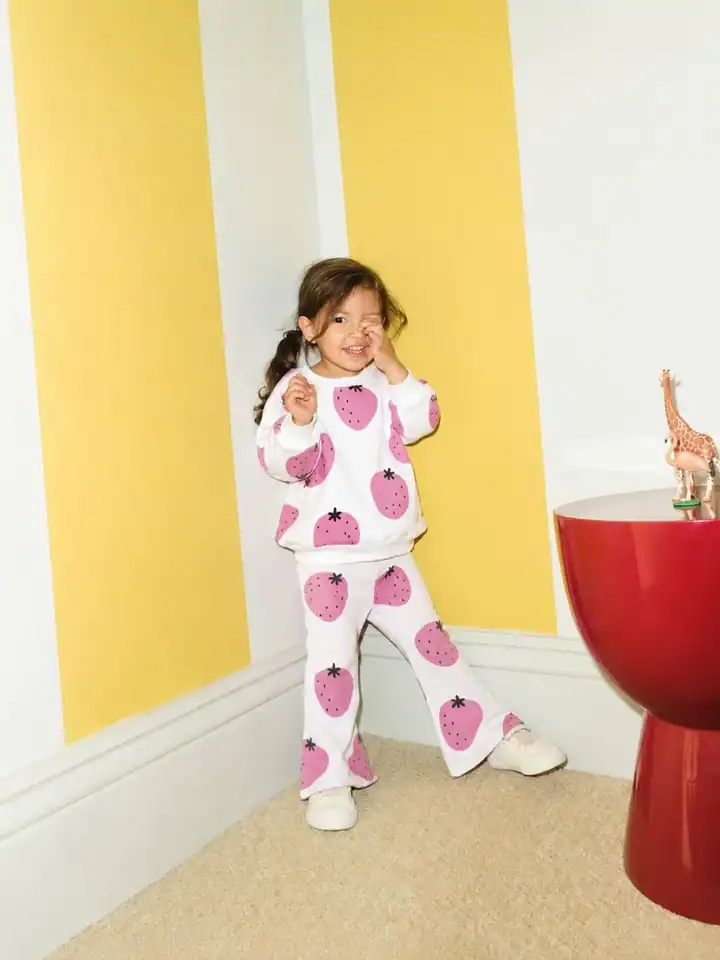
Measure the child before converting the label
Use a wall-mounted measure for standing height and a flexible tape for body circumferences. The child should stand naturally in light clothing. Keep the tape level and close to the body without pulling it tight.
Record weight as a secondary check when the supplier provides a weight range. Height usually gives a clearer starting point for children's clothing, while chest, waist, hip and inside leg help identify where two children of the same height may need different cuts.
- Chest: measure around the fullest part of the chest, keeping the tape horizontal.
- Waist: measure around the natural waist without drawing the stomach in.
- Hip: measure around the fullest part of the seat.
- Inside leg: measure from the crotch point to the floor or to the intended trouser finish.
Use international labels as a cross-check, not a promise of identical fit
TR and EU suppliers may use age numbers, height in centimetres or both. UK labels commonly show an age band. US baby and toddler ranges often use month labels and 2T-5T before moving into numbered children's sizes. Brands choose their own grading and ease, so two labels that appear equivalent can still measure differently.
The table below is a buying crosswalk for comparing common label formats. The height bands follow a regular six-centimetre planning sequence; they are not a universal conversion standard. Replace them with the product's own chart whenever one is available.
| Series age label | TR/EU height band | Common UK label | US label to compare |
|---|---|---|---|
| 1-2 | 86-92 cm | 1-2 years | 18-24M / 2T |
| 2-3 | 92-98 cm | 2-3 years | 2T / 3T |
| 3-4 | 98-104 cm | 3-4 years | 3T / 4T |
| 4-5 | 104-110 cm | 4-5 years | 4T / 5T |
| 5-6 | 110-116 cm | 5-6 years | 5 / 6 |
| 6-7 | 116-122 cm | 6-7 years | 6 / 7 |
| 7-8 | 122-128 cm | 7-8 years | 7 / 8 |
| 8-9 | 128-134 cm | 8-9 years | 8 / 10 |
| 9-10 | 134-140 cm | 9-10 years | 10 |
| 10-11 | 140-146 cm | 10-11 years | 10 / 12 |
| 11-12 | 146-152 cm | 11-12 years | 12 |
| 12-13 | 152-158 cm | 12-13 years | 12 / 14 |
| 13-14 | 158-164 cm | 13-14 years | 14 |
| 14-15 | 164-170 cm | 14-15 years | 14 / 16 |
US numbered sizes vary especially after toddler sizing. Do not relabel a product from this table alone; retain the supplier code and measurements.
Read the wholesale assortment as pieces, not only ages
A series written as 1-2-3-4-5 may mean five pieces, one in each listed size. Another supplier may write 1-2, 2-3, 3-4, 4-5 and 5-6 for a five-piece age-band series. The number of labels and the number of garments must be confirmed rather than inferred from the first and last age.
Record the product code, every size, quantity of each size, unit price and series total. If a size is duplicated within the assortment, note that duplication explicitly. It changes both the stock mix and the cost per series.
Add growth room at the measurement that needs it
A child close to the top of a height band may need the next size, but height alone does not decide the fit. Check chest and hip room for fitted garments and inside leg for trousers. Outerwear may already include layering ease; occasionwear may have less room through the bodice.
For a retailer, the safer stock response is often to carry adjacent sizes and explain the measurement method. That is more precise than telling every customer to buy one age larger.
Keep one size record through catalog, order and delivery
Do not translate the size differently at each stage. The supplier's original label should remain on the buy sheet, order confirmation and receiving check. A local conversion can sit beside it for customer service, clearly marked as a guide.
When the cartons arrive, check the label count against the confirmed assortment before merging the garments into shop stock. This catches a missing or repeated size while the product code and order record are still easy to trace.
Measure at a consistent time and repeat doubtful results
Small differences in posture, clothing and tape position can change a measurement. Use the same method each time and repeat a surprising value before choosing a size. Standing height should be taken without shoes on a level surface, with the child standing naturally. A thick jumper under the tape can add more uncertainty than the apparent precision of a one-centimetre result suggests.
Write the date beside the measurements because children grow and an old record may no longer describe the current fit. For retail customers, explain the method in plain language and allow them to provide the measurements they can take reliably. Do not ask a parent to force a child into a rigid pose for the sake of a clothing estimate.
Distinguish body measurements from garment measurements
A body chest measurement is taken around the person. A garment chest is commonly measured across the laid-flat item and may need to be doubled, depending on the supplier's convention. The garment must be larger than the body where wearing ease is intended. Comparing a flat half-chest directly with a full body circumference produces a serious error.
Ask whether the chart lists body dimensions, finished garment dimensions or both. Keep the unit and method in the column heading. For elastic waists, record relaxed and comfortably extended garment measurements when supplied. For outerwear, note that the pattern may already allow for layers; adding the same allowance again can create an unnecessarily large fit.
Handle baby and toddler labels separately
Baby ranges often use months, height or weight bands, while toddler ranges may introduce age codes or US labels such as 2T. The boundary is not consistent across brands. A 24-month item and a 2T item can differ in proportions or intended fit even when both appear close in age. Compare the specific chart and garment rather than treating the labels as synonyms.
For babies, room for a nappy, safe neck openings and the position of fasteners affect fit alongside height and weight. Avoid buying excessive length as growth room when it causes fabric to cover hands, gather around feet or interfere with movement. Product design and intended sleeping or daywear use also matter, and destination safety rules take precedence over a general age chart.
Expect grading to change through older-child sizes
As children grow, height alone explains less of the variation in body shape. Two children at the same height may have different chest, waist, hip and inside-leg needs. Older-child ranges can also split into different cuts. A numerical US label or age band therefore becomes less reliable as a direct conversion when it is separated from measurements.
When a series covers 8-14 years, request the chart for that exact range and inspect how increments change between sizes. A regular six-centimetre planning band is useful for a buying grid, but the garment may not grow by the same amount at every point. Record any slim, regular or relaxed cut description only when the supplier defines it for the product.
Treat dresses, trousers and outerwear as different fit problems
A fitted dress may be decided by chest, waist and bodice length before total height. Trousers need waist, hip, rise and inside leg. A coat needs shoulder and chest room plus the intended layer beneath it. Selecting every category from one age conversion ignores the measurement that controls comfort in each garment.
Build product-page guidance around the controlling measurements. Include garment measurements when the supplier can provide them consistently, and explain how they were taken. Avoid false precision: a handmade embellishment or elastic construction can create small variation. The goal is to help the customer compare, not to imply every physical piece is identical to a digital table.
Map a series before deciding its customer coverage
Place every label in the wholesale run against the shop's working height and age grid. Mark uncertain conversions and retain the supplier code. This reveals gaps between adjacent series and overlaps where two labels may serve a similar customer. The overlap can be useful when cuts differ, but it should not be counted as additional age coverage without inspection.
Calculate pieces received in each planning band across the entire order. Several different products may all add stock to ages 4-6 while older sizes remain thin. Reviewing only one series at a time hides this concentration. A combined size-depth table shows whether the final order reflects actual customer demand.
Publish conversions with scope and revision dates
A retailer's conversion table should say which brands or products it covers, whether values are body or garment measurements, and when it was reviewed. Do not place one universal-looking chart beside products from unrelated suppliers unless it is clearly labelled as a general measuring guide. Product-specific data should appear closer to the purchase decision.
When a supplier changes grading, update the product record without rewriting historical orders. Keep the original label in order and receiving documents so a return or repeat request can be traced. A revision date gives staff and customers a way to distinguish current guidance from an older screenshot.
Use fit feedback without collecting unnecessary personal data
A shop can improve guidance by recording whether a product ran small, expected or large and which measurement caused the issue. It does not need to retain a child's name or full body profile for general assortment analysis. Aggregate fit reasons by product code and size, and follow applicable privacy requirements for any customer information that is kept.
Review feedback only after checking starting stock and sales volume. Three comments on a high-volume model may represent a different rate from three comments on five sales. Combine feedback with returns, exchanges and direct garment measurements before changing the published recommendation.
Create a repeatable size-support answer
Give sales staff a standard sequence: ask for current height, identify the controlling body measurement for the garment, compare the product-specific chart, explain whether the values are body or garment measurements, and mention any verified fit note. The sequence should guide a choice without claiming certainty when the child cannot try the item on.
Keep the answer connected to the exact product code and revision. If staff use a screenshot or message template, update it when the chart changes. Consistent guidance reduces contradictory advice across channels and produces cleaner feedback about where the chart or product description still leaves a real question.
Worked example: choose between two adjacent labels
A child measures 121 cm in height, with a chest measurement near the upper end of the supplier's 116-122 band. The product is a fitted occasion dress. The next label begins at 122 cm, but moving up on height alone may make the shoulder and bodice length too large. The retailer checks the product's chest, waist and bodice guidance and asks whether the table contains body or garment measurements before giving a recommendation.
For a relaxed sweatshirt from another supplier, the same child may remain comfortably within the smaller height band because the garment includes ease. For trousers, inside leg and waist adjustment could control the choice. The three products demonstrate why one age or height conversion cannot settle every category. The controlling measurement follows the garment's construction and intended fit.
The customer receives the original labels, the measurement comparison and a clear statement that the chart is guidance when the garment cannot be tried on. The shop records any later exchange against the exact product code, not against the broad age label. Over time, several consistent outcomes may support a product-specific fit note, while one case remains useful service information rather than a universal rule.